
A visual data explorer to view your SQL result set and easily total, sort, format, and group it (grouping is done by dragging columns to the header and groups can easily be collapsed/expanded and show column subtotals). Toad For Oracle 32 Bit free download - Toad for Oracle (64-bit), Bit Che, Adobe Captivate (32-bit), and many more programs.
Prerequisites
- CrossOver for Mac
- GDI+ library (for Toad version 11.5 only)
- Toad for Oracle MSI installer
- Oracle Instant Client
A Word of Caution… (aka “The Disclaimer”)
As excited as I am that Toad runs on Mac within CrossOver, I have to temper things a bit by admitting that it has not been fully tested. You may also find that this may or may not work with your specific OS/software/version combination. So, until this is fully tested, verified, and officially supported by Quest, please understand that your mileage may vary.
Configuration (On to the fun stuff!)
- 15” MacBook Pro (2.5GHz Intel i7, 8Gb RAM)
- OS X Lion 10.7.3
- VMWare Fusion 4.1.2
- Windows 7 (64-bit)
- Oracle 11.2.0.1 Enterprise Edition
- CrossOver for Mac 11.0.3
- Toad for Oracle 11.0 (professional, commercial)
- GDA+ library
- Oracle Instant Client 11.2.0.3 for WINDOWS (32-bit)
To begin, make sure you have the following:
Toad for Oracle: You’ll need the commercial edition MSI installer which is provided on our Support page. The regular EXE installer uses a proprietary installation wrapper which doesn’t work well in CrossOver for Mac. I’ve tried Toad 11.0 and 11.5 to date…
- Toad for Oracle MSI installerhttps://support.quest.com/Search/SoftwareDownloads.aspx?ProductID=268435520&ProductName=Toad%20for%20Oracle
Oracle Instant Client
Download the 32-bitInstant Client – Basic and Instant Client – SQL*Plus from http://www.oracle.com/technetwork/topics/winsoft-085727.html
CrossOver for Mac (www.codeweavers.com)
It’s about $50 for a license, but you can start with a 14-day trial to give you enough time to kick the tires on this…
Step 1: Install CrossOver for Mac
This is real straightforward. If you get stuck here, stop; this article probably isn’t for you.
Step 2: Install Toad for Oracle
Installation via CrossOver is pretty straightforward:
Go to Configure > Install Software… and select “Unsupported Application”
Next, select your Toad for Oracle MSI installer by clicking on the “Select an installer” section. Use the first option: “Choose Installer File
In the next section, choose “New winxp Bottle…” and give it a name
Click Install and step through the Toad for Oracle installer.
CAUTION: If installed Toad for Oracle v11.5 you will need to instll the GDI+ library first. Otherwise, CrossOver will crash when you launch Toad. You can download & install it from here: http://www.codeweavers.com/compatibility/browse/name/?app_id=8227. Make sure you install it into teh same Bottle as Toad for Oracle 11.5.Once everything is installed, you should have a shiny new Toad icon in your Launchpad!
Toad Sql Free
Step 3: Connectivity and Environment Variables
Now that we have Toad installed, we need to configure our instant client. Assuming you’ve already downloaded the two packages referenced above, go ahead and unzip them. I recommend placing them all together into a single directory like /instantclient_11_2.
Now create /network/admin folder inside there. This is where we’ll place the tnsnames.ora file (which we have to create). Open your favorite text editor (mine’s TextWrangler) and create your tnsnames.ora file using this structure below. Be sure to replace hostname and SID with the appropriate data for your Oracle instance.
(DESCRIPTION =
(ADDRESS = (PROTOCOL = TCP)(HOST = hostname)(PORT = 1521))
(CONNECT_DATA =
(SERVER = DEDICATED)
(SERVICE_NAME = SID)
)
)
CAUTION: If you’re using TextEdit, stop. TextEdit likes to default to RTF formatting which will wreak havoc with Oracle’s OCI. Save yourself the headache of troubleshooting connection problems and avoid using RTF format…
Once you have your instant client folder arranged and your tnsnames.ora file created, you’ll need to move it over to the C: drive of the CrossOver emulator. From CrossOver, click Configure > Manage Bottles… and select your new bottle. Click on the “Advanced” tab and then the “Open C: Drive in Finder” button.
Copy your shiny new /instantclient_11_2 folder to the root of C: as you see here:
Next, we need to run regedit to add a few environment variables. Back over to CrossOver, click Configure > Manage Bottles… and select your bottle. Click on the “Control Panel” tab and choose “Task Manager”.
In the Task Manager, click File > New Task (run…) and enter “regedit”
Now let’s add some keys. First, navigate to HKEY_CURRENT_USEREnvironment and add a new String Value as “PATH” with data “c:instantclient_11_2”. (NOTE: If PATH already exists, just append c:instantclient_11_2 to the end, separated by a semi-colon.)
Next, navigate to HKEY_LOCAL_MACHINESOFTWARE and add a new key named “Oracle.” Then add a new String Value as “ORACLE_HOME” with data “c:instantclient_11_2”. Lastly, add one more String Value as “TNS_ADMIN” with data “c:instantclient_11_2networkadmin”.
Let’s check our configuration and see if we’ve got everything set up properly. From the CrossOver menu click Programs > Run Command… In the new window which opens, use the dropdown to select the appropriate Bottle and then expand Debug Options and click “Open Shell.” This will open a terminal window on the Mac and set the environment variables to CrossOver’s Bottle. To invoke the Windows Command Prompt just type wine cmd. If all goes well you should see a familiar C:> prompt. Type in “sqlplus” to step into SQL*Plus and connect using your Net Service name defined in the tnsnames.ora file
Toad For Mac Download

If you can’t connect at this point, I think it’s a good idea to fiddle with your tnsnames.ora and double check your network settings before moving on.
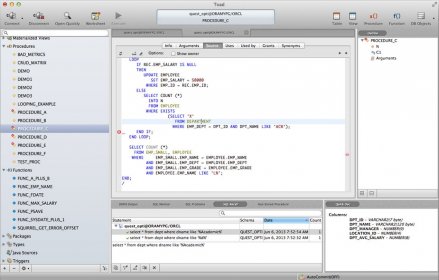
Now that we’ve installed everything and verified connectivity, let’s fire up Toad for Oracle! You can use that shiny new Toad icon in your Mac OS X Launchpad or run it from CrossOver’s menu by clicking Programs > Quest Software > Toad for Oracle > Toad for Oracle 11
The program seems to run fine for most things, though the painting of windows seems a little slow.For a more native experience, take a look at Toad Extension for Eclipse. It’s not as feature-rich as Toad for Oracle, but it’s free and doesn’t require an emulator or virtualization…
-Haji Mohamed
Introducing: Vision-Assisted Schedule Takeoff (VAST)
| ||||